Organ meats were once prized cuts of meat and were always cherished in the hunter gatherer culture. Today, they are often regarded as “waste meat” and the practice of eating such meats has lost it’s popularity. Unfortunately with the decrease in organ meat consumption, we lost the education along with it.
Liver is one of the most nutrient dense foods on this planet because it contains such a high concentration of essential vitamins and numerous minerals. It is often referred to as “nature’s multivitamin”.
Liver is particularly high in B vitamins, and minerals, including iron, magnesium, selenium and zinc, and important fat soluble vitamins like vitamins A, D, E and K. These are all vital nutrients for maintaining a healthy body and mind.
Organ Meat Benefits
Environmentally Conscious
Eating organ meats reduces food waste. As these cuts of meat aren’t particularly popular and they often get thrown out and contribute to the vast food garbage issue that our world is suffering from. Because of their lack of popularity, organ meats can often be found for a very reasonable price. Contacting your local butcher to source your livers will be your best bet here.
Best Source of Absorb-able Iron
Muscle and organ meat contain a form of iron called heme iron. Iron in this form is highly bioavailable for the body, which means it’s easily absorbed.
Excellent Source of Protein
Getting adequate amounts of protein is important for the body’s building and repair functions. This is particularly important for retaining muscle mass.
Quality, Quality, Quality
The most important thing to consider when purchasing your chicken liver is ensuring it is sourced from a quality supplier and ideally a local farmer.
Because the liver is a detox organ, many toxins get filtered through it but are then stored in the fat cells of the animal. For this reason (and for the humanity of the animal), sourcing your livers from non GMO, organic and free range chickens is vital.
Happy animals are the healthiest animals. When animals are raised in a stressful environment, their survival tactic is to store extra fat around their organs for protection. Yet another reason to choose free range organ meats as they are typically more lean.
I ordered the chicken liver used in my recipe from Meatme.ca. They are a company that provides ethically sourced meat and delivers it right to your door! The livers came from Lentelus Farms in Courtenay, BC. Visit their farm profile to read more about them here!
Organ Meat Product Cautions
Not all organ meat products contain all of these health benefits. Store bought pâté has a frightening amount of ingredients nor are there any indications of the meat being sourced ethically or organically.
Some companies will plaster words like “healthy” or “natural” onto their labels but don’t be fooled, always read the product ingredient list before purchasing.
Make Your Own Pâté- It’s So Easy!
So what’s the best way to ensure your pâté is good quality? Make it yourself!
I was pleasantly surprised to find out how simple pâté is to make! The only issue I came across when doing research for a recipe was the scary amount of butter that was being used. So I decided I needed to develop a recipe that was clean, simple, healthy, and dairy free.
Butter is typically used for the fat content of pâté. My fat hack? Coconut oil.
Coconut oil is the perfect fat substitute as the flavour doesn’t alter the taste of the pâté. Coconut oil is made 100% of a fat called MCTs (medium chained triglycerides) which carry many health benefits. After digestion, MCTs travel to the liver where they are immediately used for energy.
You truly don’t need much to make a delicious batch of homemade pâté. With just a few ingredients, that you likely already have in your pantry, and a good quality source to purchase organ meat, you’ll have fresh pâté in a matter of minutes!
Chicken Liver Pâté Recipe
Yields roughly 1 cup of pâté – fits perfectly in an 8oz short mason jar
Ingredients:
1/2 pound of organic, non GMO, free range chicken livers
1/4 lemon
1/4 onion, chopped
1 clove garlic, chopped
1 tbsp balsamic vinegar
2 tbsp coconut oil, divided
1 tbsp fresh thyme (plus additional for garnish)
1/4 tsp salt
1/8 tsp pepper
Important kitchen tools needed:
Digital meat thermometer
Food processor (mini or regular sized) or a hand held immersion blender
Directions:
- Remove the livers from the package and place in bowl, discarding any access blood or liquid.
- Take the quarter lemon and squeeze it over the livers and stir. Place in fridge for 1 hour.
- While the livers are soaking in the lemon, prepare the other ingredients. Chop the onion, garlic, thyme, and set aside.
- After the hour, remove livers from fridge and rinse thoroughly, place on plate and pat dry with paper towel.
- Heat 1 tbsp of the coconut oil in a medium sized skillet over high heat.
- Once oil is hot, but not smoking, turn the heat down a little and add the onions to the pan, saute until translucent (about 4-5 minutes).
- Add the livers, garlic, thyme, and balsamic vinegar to the pan and stir together. Cook until balsamic has slightly reduced.
- Place a lid on the pan and let this cook until the internal temperature of the liver has reached 165°F. It is important to cook the liver all the way though (much like chicken). The outside of the liver will turn brown but the inside will likely remain pink (and might appear bloody), this is okay as long as the internal temperature is 165°F or above. Take your digital meat thermometer and insert it into the middle of the largest piece of liver to check. Over cooking the liver will make the pate harder to spread. Cooking it to as close to (but above) 165°F as possible will ensure a creamier consistency for your pâté.
- Once the livers are cooked, remove from heat and let cool for 5 minutes.
- Once slightly cooled, place the ingredients into your food processor (or if using immersion blender, into a container where it will blend). Add the remaining 1 tbsp of coconut oil, salt and pepper
- Process until smooth. This make take a couple minutes and you might need to scrape the ingredients down from the sides towards the blades.
- Once desired consistency is achieved, place your pâté in a jar. An 8oz stubby jar is the perfect size for this recipe. Close with lid and place in fridge to cool for at least 2 hours.
- When ready to serve, take lid off of jar and garnish with fresh thyme. Create your charcuterie board with your favourite ingredients!
- Your pâté can be stored in the fridge for up to 5 days. It can then be placed into the freezer for up to 4 months!
Charcuterie Goals
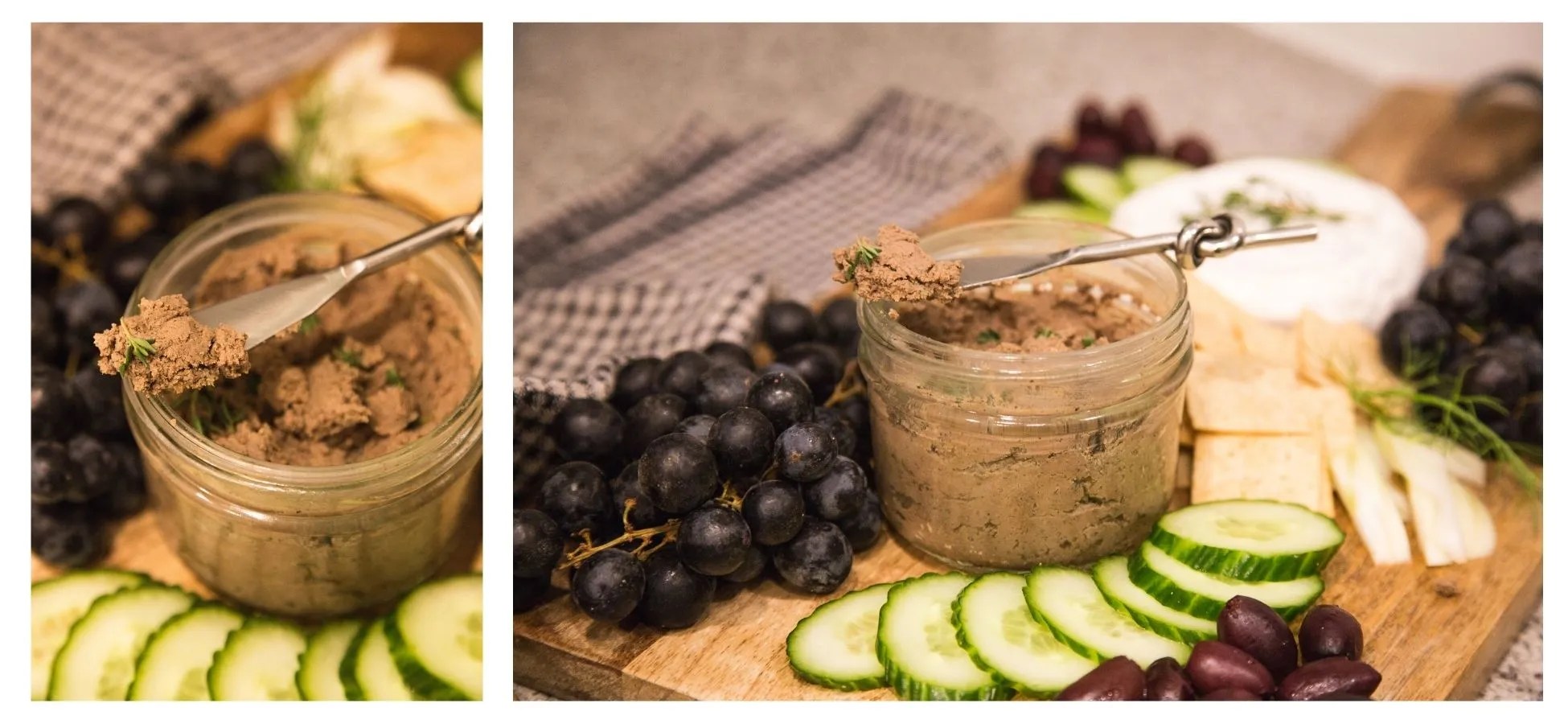
Pictured on my charcuterie board is: homemade pâté, the BEST gluten free crackers (by Simple Mills), Little Qaulicum Cheeseworks brie, grapes for sweetness, cucumber for freshness, kalamata olives for saltiness, and fresh fennel for digestive aid, served with Poplar Grove Pinot Gris.

The key to a good charcuterie board is flavour diversity. Try to include an ingredient from at least three of the flavour profiles (sweet, salty/umami, sour, bitter, spice) and multiple textures. This promotes experimentation with flavour combinations that keep your taste buds on edge and ensures no two bites are the same!
I recommend serving white or a light red wine with your homemade pâté. White acidic wine can bring out the creamy pate flavours and cut through the richness, but hey, I’m no sommelier so use whatever excites your taste buds!
While an assortment of meat and cheese can typically be found on a charcuterie menu, adding some alternative foods can be a great way to add more nutrients.
- Fresh and pickled vegetables are welcomed guests on my plate as they add colour, texture and nutrient diversity!
- Olives, nuts and seeds add protein and healthy fats like omega 3s to the board.
- Fresh fruit adds sweetness, colour and health to your charcuterie menu. Consider adding berries high in antioxidants like blueberries, blackberries and raspberries. These nutrient bombs can protect your body from free radicals. Fresh figs are delish and are a definite go to fruit for my board.
- Spreads, jellies, and jams. I love adding a good red pepper jelly or fig spread to the mix. Add your favourite for a fast track ticket to flavour town!
Dairy Hangovers
I love cheese (so much), however my stomach does not share this love with me. I always include something to aid in digestion on my charcuterie board to ensure my stomach doesn’t get overwhelmed by the dairy.
Fresh fennel, ginger, papaya and pineapple are all excellent to help with digestion. Including some fresh herbs like peppermint can be great too!
Secret Ingredient
Guilt. Free. Fun.
Enjoy and happy cooking!
References:
https://pubmed.ncbi.nlm.nih.gov/1685581/
https://www.medicalnewstoday.com/articles/319229#what-is-organ-meat
https://academic.oup.com/nutritionreviews/article/74/4/267/1807413